
Plastic injection molding
Plastic injection molding is one of the key technologies in modern manufacturing, enabling the execution of even the most complex plastic components. It is a process in which raw materials are exposed to high temperature and pressure, then precisely shaped in dedicated molds. This makes it possible to produce components with complex geometries while maintaining the highest repeatability and dimensional accuracy.
This technology delivers products that meet stringent quality standards, while ensuring efficient material use and minimizing production waste. Its versatility means it is widely applied across a wide range of industries – from automotive and household appliances, through packaging and energy, to furniture, electronics, and the sports industry.
Hanplast supports its clients not only in the injection molding itself, but also in its automation. We deliver solutions that accelerate and streamline production, increase efficiency, reduce costs, and help strengthen competitive advantage.
How is a part made?
Injection molding process step by step
Material feeding
Plastic granules are supplied to the plastic injection molding machine via an automated material distribution system, directly from the silo area or a central material preparation zone.
Plastic heating
The plastic granules enter the heated barrel, where under high temperature they are transformed into a plasticized melt, ready for further processing.
Injection
The molten plastic is injected into the injection mold under pressure, filling the cavity and forming the shape of the future part.
Cooling
The filled mold is cooled, allowing the material to solidify and retain its final shape.
Part ejection
After cooling, the mold opens and the finished part is ejected using ejector pins, hydraulic cores, or a pneumatic system.
Processed materials
PS
PP
ABS
PC
PC/ABS
PC/PMMA
PA
PP/EPDM
POM
PA6 GF30
PP GF30
PP+T
PET/RPET
Cycle stages
In production practice, the injection molding process is described as an injection cycle consisting of repetitive stages. The optimization of these stages directly determines part quality and overall production efficiency.
• Closing of the injection mold
• Moving the injection unit toward the mold
• Injection of the plastic and filling of the mold cavity
• Packing/holding pressure to achieve the required shape, weight, and dimensions
• Cooling of the injection molded part and simultaneous plasticizing of the next material dose
• Opening of the mold and part ejection
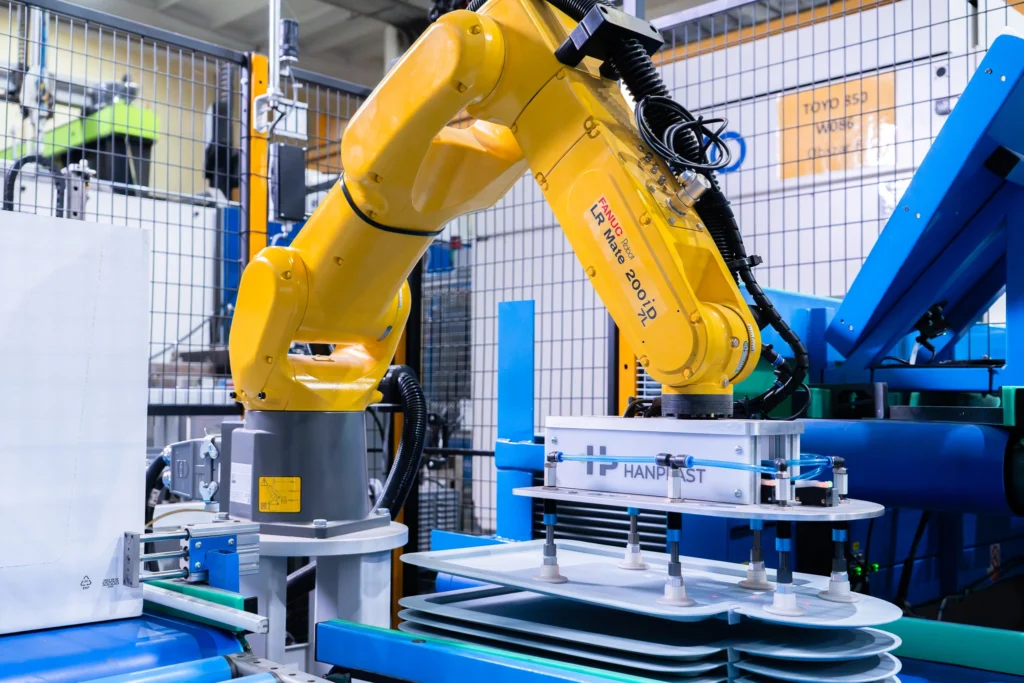
• Part removal by a robot (Cartesian or 6-axis)
• Start of a new cycle
Cycle time
The duration of the injection molding cycle is not a fixed value – it varies depending on many factors:
• size and shape of the molded part,
• mold dimensions and design,
• number of cavities in the mold,
• shot weight,
• selected process parameters,
• required clamping force,
• type of material used,
• geometry of the plasticizing system,
• operating speed of machines and robots (Cartesian / 6-axis),
• specific process requirements (e.g. multi-component injection, steam-assisted or gas-assisted molding).
TECHNOLOGIES
INJECTION MOLDING
At Hanplast, we use a wide range of injection molding technologies, allowing us to tailor the production process to the specific requirements of each product – its technical, aesthetic, and functional needs:
• Gas-assisted injection molding
• Multi-component injection molding – 2K/3K
• Conventional injection molding – transparent, single-color, and multi-color parts
• Injection molding of engineering plastics
• Overmolding with plastics – inserts, press-fits, screws
• Bioplastic injection molding – biodegradable and eco-friendly materials (biopolymers)
• High-gloss injection molding – heat & cool technology with steam generator
• In-mold automation – IML (in-mold labeling) injection molding


Production processes
Services and special processes
In addition to injection molding, we also offer complementary processes that help shorten the supply chain and accelerate order fulfillment:
- component assembly
- conventional (heat plate) and ultrasonic welding
- part finishing – grinding, milling
- quality control – production masters, finished product audits, incoming inspection (semi-finished products and raw materials), visual and dimensional inspection
- kitting and packaging of parts
- pad printing
- painting
Examples of products for various industries
Automotive industry
• bumpers • fenders • components for the automotive industry • technical parts and components for industrial applications
Furniture industry
• furniture components • plastic tables • children’s chairs • stadium seating
Home appliances and industry
• home appliance housings • machine housings • technical parts and components for industrial applications • subassemblies • fittings
Electronics and electrical engineering
• lamp housings • smoke detectors
Toys
• toys • plastic slides • garden tables
Other industries
• containers • buckets • hangers • waste bins • bathroom posts • lawn edging • packaging
Why is Hanplast a reliable partner?
Comprehensive engineering and design support
Our strength lies in our team – stable, experienced, and committed. Low employee turnover ensures that knowledge accumulated over the years remains within the company and elevates every project to a higher level. From the very beginning of implementation, we conduct a thorough feasibility analysis, identify opportunities to minimize production costs, and jointly define processing limits with the client. This approach shortens time to market and enables us to deliver innovative solutions tailored to the specific requirements of each product. Our specialists provide expert support in injection molding simulations, process automation, packaging selection, and logistics.
What are the stages of outsourcing and implementing injection molding services at Hanplast?


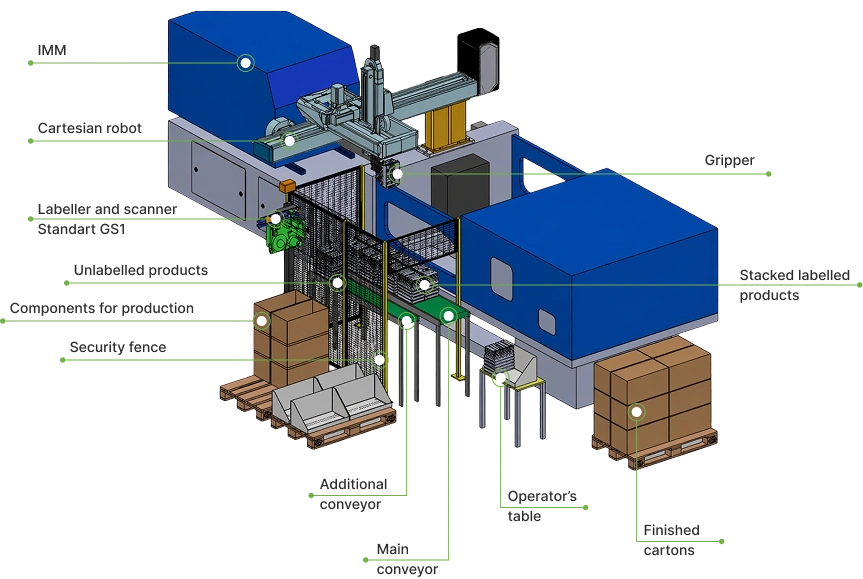
Production process automation.
We develop automation solutions tailored to the project objectives:
Quality improvement – including milling, labeling, grinding, and drilling
Cycle time reduction – part handling, dedicated end-of-arm tooling, optimization of robot and machine trajectories
Labor cost reduction – automated packaging, palletizing, integration of multiple processes within a single production cell
Internal logistics – transport of products between production halls, automatic pallet wrapping and transfer to the warehouse
Already at the quotation stage, we develop concepts for solutions and processes worth automating. We support customers with DFM (Design for Manufacturing) analysis, identifying the most efficient directions for implementation.
Tons of material production processed yearly
Injection machines
Number of molds
Modern machinery park.
Production at Hanplast takes place at our facility in Bydgoszcz, located at 3 Paciorkiewicza Street, where we operate one of the most modern machinery parks in the region.
13 900 m2
Production Area
19 000 m2
Warehouse Area
3 000 m2
Office Area
65
Cartesian robots
25
6-axis robots
69%
Share of electric machines
60 – 2000 T
Clamping force
Quality confirmed by certifications
Our products and production standards are validated by compliance certifications including ISO 28000, ISO 9001, ISO 50001, ISO 14001, ISO 45001, and ISCC. Our products meet global quality standards, ensuring reliability and safety across every industry.


